國際研究與政策依據
1. United Nations Environment Programme(UNEP)《Global Status Report for Buildings and Construction 2024/2025》指出建築與營建部門約占全球 32%能源消耗,並貢獻 34%二氧化碳排放。
https://www.unep.org/resources/report/global-status-report-buildings-and-construction-2024
2. International Energy Agency(IEA)《Energy Efficiency 2025: Buildings》說明建築部門約占全球 30%能源需求,且隨城市化與氣候變遷,冷房需求將持續成長。
https://www.iea.org/reports/energy-efficiency-2025
3. International Energy Agency(IEA)《Energy Efficiency Policy Toolkit 2025: Buildings》強調建築減碳需結合法規、資訊揭露與金融工具,包括綠色房貸、績效導向貸款與行政流程優化。
https://www.iea.org/reports/energy-efficiency-policy-toolkit-2025-buildings
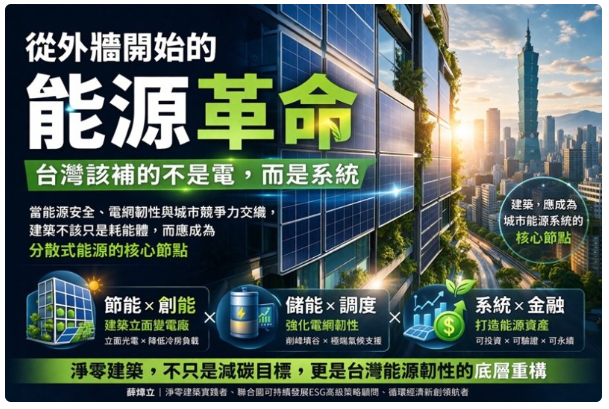
4. Building-integrated photovoltaics Jiang et al., Building façade photovoltaics enhance global climate resilience指出立面型光電除發電外,亦具備降低冷房負載與提升城市氣候韌性之效益。
https://www.nature.com/articles/s41558-026-02621-0
5. Nature Climate Change
Global energy and climate benefits from photovoltaics integrated in building façades(Research Briefing)
為上述研究之延伸整理,說明立面光電對能源與氣候之整體效益。
https://www.nature.com/articles/s41558-026-02621-0
6. Zhang et al., Worldwide rooftop photovoltaic electricity generation may mitigate global warming研究指出屋頂型光電至2050年可減少約 0.05–0.13°C全球暖化幅度。
https://www.nature.com/articles/s41467-022-29320-6
7. Government of Japan
《The 7th Strategic Energy Plan》(英文摘要)提出能源轉型採取多元結構,預估2040年:再生能源約 40–50%、核能約 20%、火力約 30–40%。
https://www.enecho.meti.go.jp/en/category/others/basic plan/
8. Ministry of Economy, Trade and Industry Japan《Strategic Energy Plan》(全文)涵蓋建築效率(ZEB/ZEH)、分散式能源、跨區電網、儲能、需量反應及太陽光電回收制度等政策架構。
https://www.enecho.meti.go.jp/category/others/basic plan/pdf/7th plan.pdf作者:薛煒立/睿田能源股份有限公司執行長、聯合國可持續發展ESG高級策略顧問、台灣智慧淨零建築產業聯盟 監事、臺灣環境公義暨能源轉型常務理事、中華民國都更危老重建協會淨零轉型委員會主委